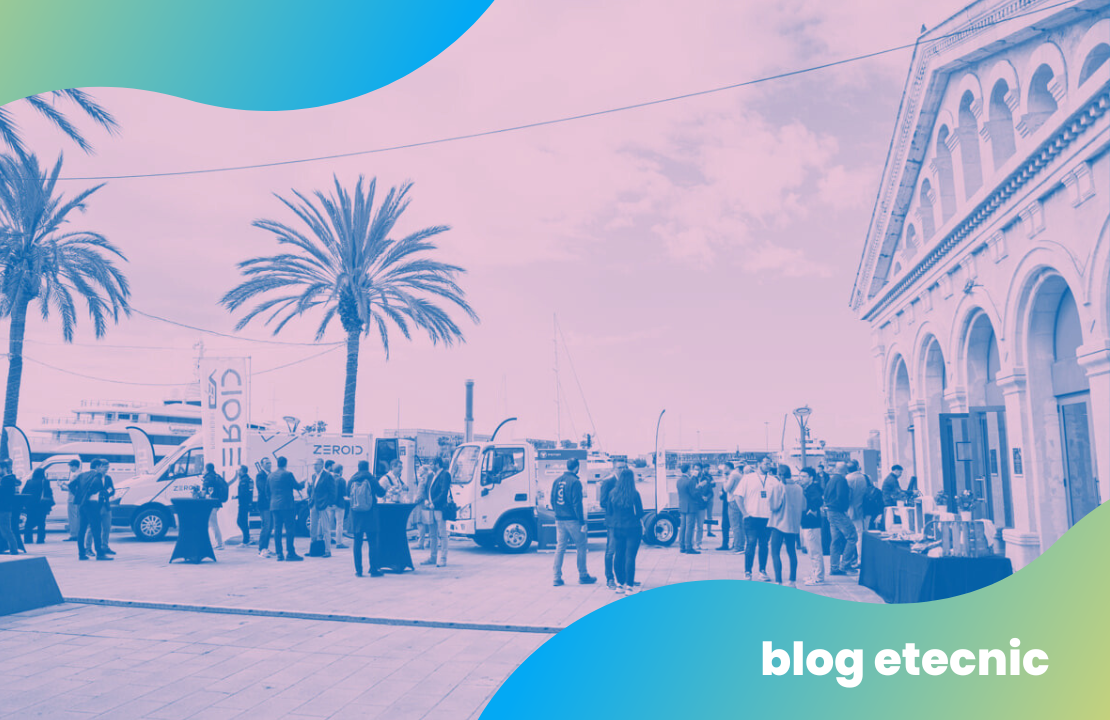
The iconic Tinglado 1 of the Port de Tarragona hosted last Tuesday, May 6th, the first Sustainable Electrified Transport Workshop, a pioneering event organized by Etecnic, in collaboration with the Port de Tarragona, APPORTT and manufacturers such as XCHARGE, NIDEC, FLOOX, FOTON TRUCKS, and OHM, bringing together the main players in the electric mobility sector and experts in transport decarbonization.
A session driving the energy transition in transport
The day was inaugurated by the president of the Port de Tarragona, Santiago Castellà, who highlighted that “ports must become sustainable, technological, and logistical hubs”. He emphasized the strategic role of the port due to its proximity to the Mediterranean Corridor and stated that “decarbonization is a shared challenge for the Port and businesses, and building electric and sustainable mobility is key”. Castellà congratulated Etecnic for its innovative role and for leading these types of initiatives.
The event featured the collaboration of leading manufacturers and companies in the sector such as XCHARGE, NIDEC, FLOOX, ZEROID, FOTON TRUCKS, OHM, FORD, QEV Technologies, as well as associations like AEDIVE, Empresas por la Movilidad Sostenible, and AGRUCAES, and leading corporations such as Calsina Carré, Sertrans and Movertis.
Cutting-edge technology and real demonstrations
Next-generation charging technologies were presented, featuring fast and ultrafast charging tests on both light and heavy electric vehicles. Among the highlighted chargers:
- XCHARGE Net Zero Series, with an integrated battery and the capacity to deliver up to 210 kW.
- NIDEC DC TOWER, a modular charger supporting up to 360 kW.
- FLOOX Lyra, the most compact fast charger in the world, with 60 kW.
Attendees were also able to test vehicles such as:
- ZEROID eC31, with Divisegur bodywork and the Tilt Tipper version.
- FORD eCustom and eTransit.
- FOTON eAumark 6TN, a 100% electric truck available in 6-tonne and 4-tonne versions, with up to 200 km of range.
- OHM 3.5TN, an electric vehicle with up to 337 km of range and 2 tonnes of payload capacity.
Key dialogues on the present and future of sustainable transport

“Ports and airports must decarbonize even more than cities,” May López, from Empresas por la Movilidad Sostenible.
“Migrating to electric mobility in transport is already viable,” Miguel Ángel Jiménez from AEDIVE.
The program featured high-level panel discussions that addressed the main challenges and solutions in the sector:
- “Charging solutions and electric vehicles”, with the participation of leading manufacturers. Speakers Àngel Valls (FLOOX), Ferran Modamio (NIDEC), Javier Sánchez (XCHARGE), and Javier Navarro (QEV Technologies – ZEROID) shared recent successful projects carried out both in Spain and internationally. The most innovative products from each brand were presented, highlighting their capacity to adapt to different operational needs. The panel made it clear that the last-mile market already offers viable, scalable solutions tailored to all logistical requirements.
- “Obstacles and challenges of transport electrification”, featuring May López (Empresas por la Movilidad Sostenible), Miguel Ángel Jiménez (AEDIVE), and Albert Campabadal (AGRUCAES). López stated: “ports and airports must decarbonize even more than cities.” Jiménez added: “migrating to electric mobility in transport is already viable.”.
- “Real cases of companies with electric fleets”, featuring insights such as those from Marina Roget, Quality and Environment Director at Calsina Carré, who highlighted the progressive electrification of their fleet and collaboration with clients. Diego Pérez, from Sertrans, explained that while some routes remain complex to electrify, last-mile delivery is already fully operational with electric energy.
- “Innovation and fleet management”, which addressed the use of data and metrics in decision-making, collaborative transport as a means of optimization, and battery leasing as an innovative solution for freelancers, presented by Guillem Pujeu (OHM). Pablo Mazón, CEO of Movertis, stated: “Digitalizing commercial routes allows for cost optimization and greater agility according to customer needs.”. Michael Arroyave, COO of Etecnic, also participated, explaining his experience in fleet electrification projects for buses and trucks in Colombia, utilizing solutions operated by EVcharge tools.
- “Business models in heavy mobility”, with a presentation by Gustavo Mezquita, New Business Director at Etecnic, who shared data regarding the current profitability of electrification on many routes, analyzing the total cost of ownership (TCO), the energy efficiency of electric vehicles, and battery lifespan as key elements for sustainable and competitive adoption.
- Rafael López-Monné, from Acció Climàtica i Territori, presented the Energy and Mobility Strategy of the Port de Tarragona, centered around dock electrification, solar energy usage, and supporting businesses to facilitate transport electrification.

Attendees were able to experience fast and ultrafast charging tests with Nidec, Xcharge, and Floox chargers, using the exhibited electric vehicles from Foton Trucks, OHM, Zeroid, and Ford.
Conclusions and closing with a strategic vision
The workshop concluded with a closing speech by Gustavo Mezquita, who reaffirmed that “transport electrification is already a profitable reality and brings significant financial savings,”, pointing out that 2025 will be a key turning point for the electrification of both heavy and light transport.
A shared commitment to decarbonization
With an attendance of over 80 sector professionals, the session demonstrated a growing commitment to sustainable mobility and positioned Tarragona as a benchmark in transport electrification. The event highlighted how collaboration among public administrations, industry, and logistics operators can accelerate the energy transition. It also emphasized the need to overcome bureaucratic hurdles, promote education against misinformation, and facilitate access to funding, data, and infrastructure.