
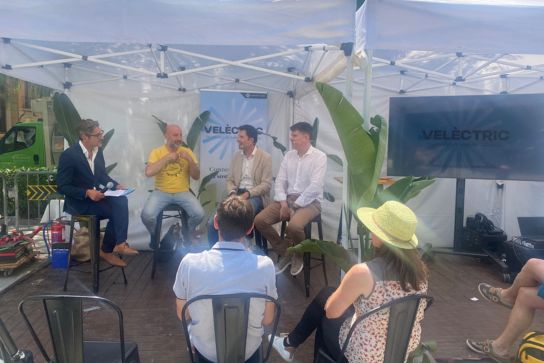
Within the framework of the Velectric exhibition in Reus, a round table discussion was held with the participation of Jorge Ríos, CEO of Etecnic Movilidad Eléctrica, accompanied by representatives from Som Mobilitat and Solargest, to analyze the main challenges and opportunities of electric mobility in our territory.
The 9th Velectric Electric Vehicle Exhibition, organized by the Reus City Council through the Department of Environment, Sustainability, and Public Space, aims to promote sustainable mobility habits as well as raise citizen awareness regarding environmental preservation.

Charging infrastructure: a shared challenge
Jorge Ríos opened the debate by highlighting the need to collectively face the industry’s challenges. According to him, “we must increase the presence of charging points by taking advantage of existing public grid connections and integrating self-production systems with solar energy and batteries.” This combination not only facilitates local production and storage but also positions city councils as more competitive administrations: “they will be able to avoid high costs, such as grid charges and tolls, and access cheaper energy.”
Som Mobilitat emphasized that many municipalities have not yet firmly committed to electric mobility and that, to reverse this situation, it is necessary to boost a robust charging network by combining public, private, and collective initiatives. They also highlighted the potential of electric carsharing, an affordable, easy-to-use alternative that can be managed entirely through an app.
For its part, Solargest stressed the flexibility of solar infrastructure, which is capable of powering charging points up to 2 km away. This opens the door to installations on the rooftops of public buildings without needing to locate them directly at the charging spots, particularly in shaded areas.
Education and technology: keys to an efficient transition
Ríos noted that there is a lack of education to explain how electric mobility actually works. “It is a self-financing service through payment for charging; therefore, it should not represent an extra cost for city councils,” he said. Furthermore, he pointed out the EVcharge platform as an example, which solves operational problems and allows users to locate charging points and make payments within a single application.
Despite the perception of a lack of infrastructure or high costs, Ríos provided reassuring data: “the current charging network is sufficient for the electric vehicles in circulation, and Spain has a higher ratio of points per vehicle than the European average.” However, electric vehicle adoption is still low, at around 7%. According to Ríos, “infrastructure must lead the way because this will build trust and increase sales.” He also noted that the total operational cost of an electric vehicle over five years matches that of a diesel vehicle, with clear advantages in maintenance and cost per kilometer.
Misinformation: a barrier to overcome
The three speakers agreed in denouncing the misinformation surrounding the sector. Ríos refuted the alleged danger of charging and recalled that, in Sweden, only about twenty of the thousands of annual vehicle fires affect electric cars. He also criticized cases like the one in Madrid, where a vehicle fire was mistakenly attributed to an electric car.
The future: clean cities and smart mobility
Looking to the future, Som Mobilitat pointed to the growing impact of climate change, heatwaves, and pollution-related illnesses, and defended the electrification of cities as a public health measure.
Solargest called for bolder politicians who do not just declare Low Emission Zones (ZBE) but guarantee their effective enforcement through measures such as installing cameras and control systems.
To close the event, Jorge Ríos offered a positive and hopeful outlook: “The mobility of the future will be electric and based on renewable energies. We will see services like carsharing grow, and there is no other solution that is more efficient or smarter.” He anticipated a decade of great advancements with long-range vehicles and covered charging HUBs, where “shade will become an added and highly sought-after value.”